
Internal vs External Links: What They Mean and Why They Matter for SEO
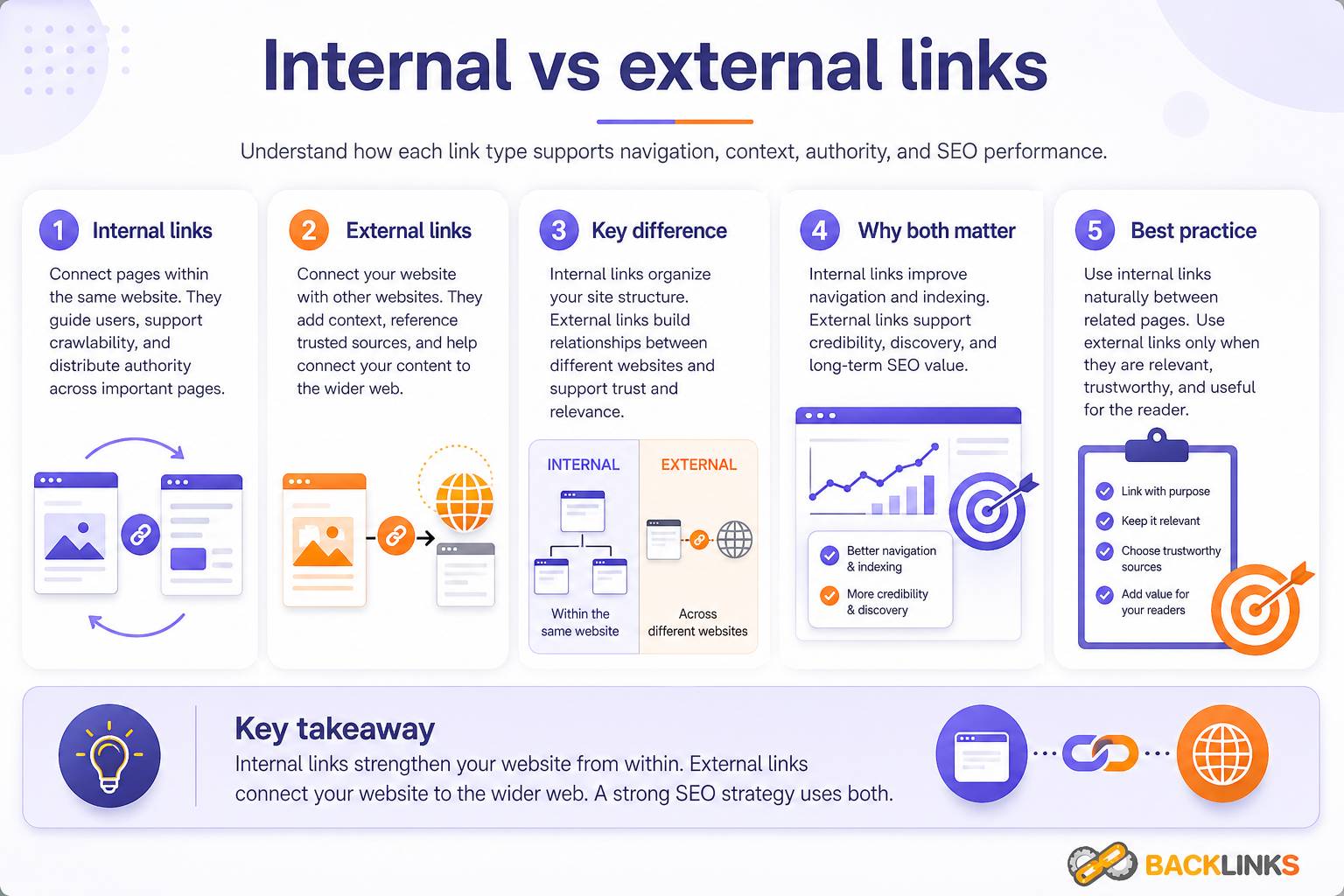
Internal vs external links is an important SEO concept because both link types help search engines and users understand how web pages connect, but they work in different ways. Internal links connect pages within the same website, while external links point from one website to another.
For website owners, marketers, and SEO professionals, understanding the difference matters because links influence crawlability, authority flow, user experience, topical relevance, and trust. A strong SEO strategy does not rely on one type of link alone. It uses internal links to organize and strengthen a website, and external links to connect that website with the wider web.
This article explains what internal and external links are, how they differ, why each matters, and how to use them strategically without over-optimizing.
What Are Internal Links?
Internal links are hyperlinks that connect one page of your website to another page on the same domain.
For example, if a blog post about linkbuilding links to another article on your site about backlinks, that is an internal link. The user stays within the same website, but moves to a different page.
Internal links are important because they help create structure. They show search engines which pages are connected, which pages are important, and how content is grouped across the site.
They also help users navigate naturally. A visitor reading about backlinks may want to learn more about anchor text, outreach, or how linkbuilding works. Internal links guide them to the next relevant resource.
What Are External Links?
External links are hyperlinks that point from one website to a different website.
There are two ways to think about external links:
An outbound external link is a link from your website to another website.
An inbound external link, often called a backlink, is a link from another website to your website.
For example, if your article links to a trusted search engine documentation page, that is an outbound external link. If another marketing website links to your article, that is a backlink for your site.
External links help connect your content to broader sources, references, and online authority signals. They can support credibility when used carefully, and backlinks can directly contribute to SEO authority.
The Main Difference Between Internal and External Links
The main difference between internal and external links is where they point.
Internal links point to pages on the same website. External links point to pages on a different website.
That difference changes how they function in SEO.
Internal links mainly help with:
- Website structure
- Crawlability
- User navigation
- Authority distribution within your site
- Topical relationships between pages
External links mainly help with:
- Connecting to outside references
- Building credibility
- Earning authority through backlinks
- Driving referral traffic
- Showing relationships between different websites
Both link types matter, but they solve different problems.
Internal links help search engines understand your own website. External links help search engines understand how your website fits into the wider web.
Why Internal Links Matter for SEO
Internal links are one of the most controllable parts of SEO. Unlike backlinks, which depend on other websites, internal links are fully within your control.
They Help Search Engines Discover Pages
Search engines crawl websites by following links. If an important page has no internal links pointing to it, search engines may have difficulty finding or prioritizing it.
A page that is only accessible through a sitemap may still be discovered, but it is usually weaker from a structural perspective than a page linked from relevant content.
Internal links make your website easier to crawl. They create clear paths from one page to another.
They Help Distribute Authority
When a page earns backlinks, it can gain authority. Internal links help distribute some of that authority to other relevant pages.
For example, an article about linkbuilding may earn backlinks from external websites. If that article links internally to pages about backlinks, outreach, or anchor text, it can help support those related pages.
This does not mean internal links magically create authority. They help guide how existing authority flows through your website.
They Strengthen Topic Relationships
Internal links help search engines understand topical relationships.
If several pages about linkbuilding, backlinks, anchor text, and outreach all link to one another in a logical way, search engines can better understand that these pages belong to the same subject area.
This supports topical authority because the site is not publishing disconnected articles. It is building a structured body of knowledge.
They Improve User Experience
Good internal links help users continue their journey.
A reader who lands on an article about internal vs external links may also need to understand what a backlink is, why linkbuilding is important, or how linkbuilding works. Relevant internal links reduce friction by guiding users toward useful next steps.
This can improve engagement, reduce dead ends, and make the website feel more helpful.
Why External Links Matter for SEO
External links also play an important role, but their impact depends on whether you are linking out to another site or earning backlinks from other sites.
Outbound External Links Support Trust and Context
Linking to credible external sources can make your content more useful. It shows that your article is connected to reliable information and not written in isolation.
Outbound links are especially useful when referencing:
- Official documentation
- Research
- Industry standards
- Tools or platforms
- Original sources
However, outbound links should be used with judgment. Linking to low-quality or irrelevant websites can weaken user trust.
Backlinks Build Authority
Inbound external links, or backlinks, are one of the most important authority signals in SEO.
When another website links to your page, it may indicate that your content is valuable enough to reference. Search engines can use that signal to evaluate trust, relevance, and authority.
Backlinks are especially important for competitive keywords. If many websites have similar content, strong backlinks can help search engines identify which pages are more trusted.
External Links Can Drive Referral Traffic
External links can also send real visitors from one website to another.
If a relevant industry website links to your content, users who click that link may already be interested in your topic. This traffic can be valuable because it comes through a trusted recommendation.
Referral traffic is not always large, but it can be highly relevant.
Internal Links vs Backlinks
Internal links and backlinks are often discussed together, but they are not the same.
Internal links come from your own website. Backlinks come from other websites.
This difference matters because backlinks are external validation. You control your internal links, but you do not fully control who links to your site.
A good SEO strategy uses both.
Backlinks bring authority into your website. Internal links help distribute that authority to related pages.
For example, if a detailed guide earns several backlinks, internal links from that guide can help support other pages that are important for your SEO strategy.
How Anchor Text Works in Internal and External Links
Anchor text is the clickable text used in a hyperlink.
Anchor text matters because it gives users and search engines context about the linked page.
For internal links, you have more control over anchor text. This allows you to use descriptive phrases that clearly explain what the destination page covers.
For example:
“Learn more about how linkbuilding works” is clearer than “click here.”
For external backlinks, anchor text is usually controlled by the linking website. A natural backlink profile includes a mix of branded anchors, partial-match phrases, URLs, and descriptive text.
The key is to avoid over-optimization. Repeating the exact same keyword anchor too often can look unnatural, especially across backlinks.
Best Practices for Internal Links
Internal links should be useful, relevant, and intentional.
Start by linking from relevant pages. A link should make sense in context and help the reader learn more about the topic.
Use descriptive anchor text. The clickable text should tell users what to expect when they click.
Avoid linking every page to every other page. Too many links can create confusion and reduce the importance of truly valuable links.
Prioritize important pages. If a page is central to your SEO strategy, it should receive internal links from related content.
Review older content regularly. As you publish new articles, add links from existing pages where relevant.
Best Practices for External Links
External links should support credibility and usefulness.
Link to trusted sources when they add value. Do not link externally just to appear authoritative. The link should help the reader understand the topic better.
Avoid linking to low-quality, spammy, or irrelevant websites. The websites you reference can affect how users perceive your own content.
Use external links naturally. If a point needs evidence, clarification, or an official source, an external link may be appropriate.
For sponsored, paid, or user-generated links, use the correct link attributes where needed. This helps search engines understand the nature of the link.
When earning backlinks, focus on quality and relevance. A few strong backlinks from trusted sources are usually more valuable than many weak links from unrelated sites.
Common Mistakes With Internal and External Links
One common mistake is ignoring internal links after publishing content. Many websites create articles but fail to connect them properly, leaving valuable pages isolated.
Another mistake is using vague anchor text too often. Phrases like “read more” or “click here” provide little context compared with descriptive anchor text.
Some websites overdo internal linking by adding too many links into every paragraph. This can distract users and reduce clarity.
With external links, a common mistake is linking to poor-quality sources. Another is avoiding external links completely out of fear of sending users away. Used properly, external links can support trust and improve content quality.
For backlinks, the biggest mistake is focusing on quantity rather than relevance and authority. Random backlinks from weak websites rarely create sustainable SEO value.
How to Use Internal and External Links Together
Internal and external links work best when they support the same broader strategy.
A practical approach is to start with your most important content. Identify the pages that need authority, visibility, and strong user pathways.
Then use internal links to connect related content clearly. Make sure readers can move naturally from broad topics to more specific supporting pages.
At the same time, earn backlinks to valuable pages that other websites would realistically reference. Informational guides, research-based content, practical resources, and original insights often attract links more naturally than purely promotional pages.
When external backlinks point to your strongest content, internal links can help spread that value to other relevant pages on your site.
This creates a stronger SEO system than treating each page separately.
Timing and Expectations
Internal linking can often produce faster improvements than external linkbuilding because it is fully within your control. Once internal links are added, search engines can crawl and process them over time.
External backlinks usually take longer. Earning links from other websites requires content quality, visibility, outreach, relationships, and patience.
Both link types should be reviewed regularly. As your website grows, old internal links may become outdated, new opportunities may appear, and backlink profiles may change.
SEO linking is not a one-time setup. It is an ongoing process of improving structure, relevance, and authority.
Conclusion
Understanding internal vs external links is essential for building a strong SEO foundation.
Internal links connect pages within your own website. They improve crawlability, guide users, distribute authority, and strengthen topic relationships.
External links connect your website to the wider web. Outbound links can support credibility and context, while backlinks can build authority, improve rankings, and drive referral traffic.
The strongest SEO strategies use both link types intentionally. Internal links organize and strengthen your website from within. External links build trust and authority from outside sources.
When used together, they help search engines and users understand not only what your content is about, but why it deserves attention.