
Contextual Backlinks: What They Are and Why They Matter for SEO
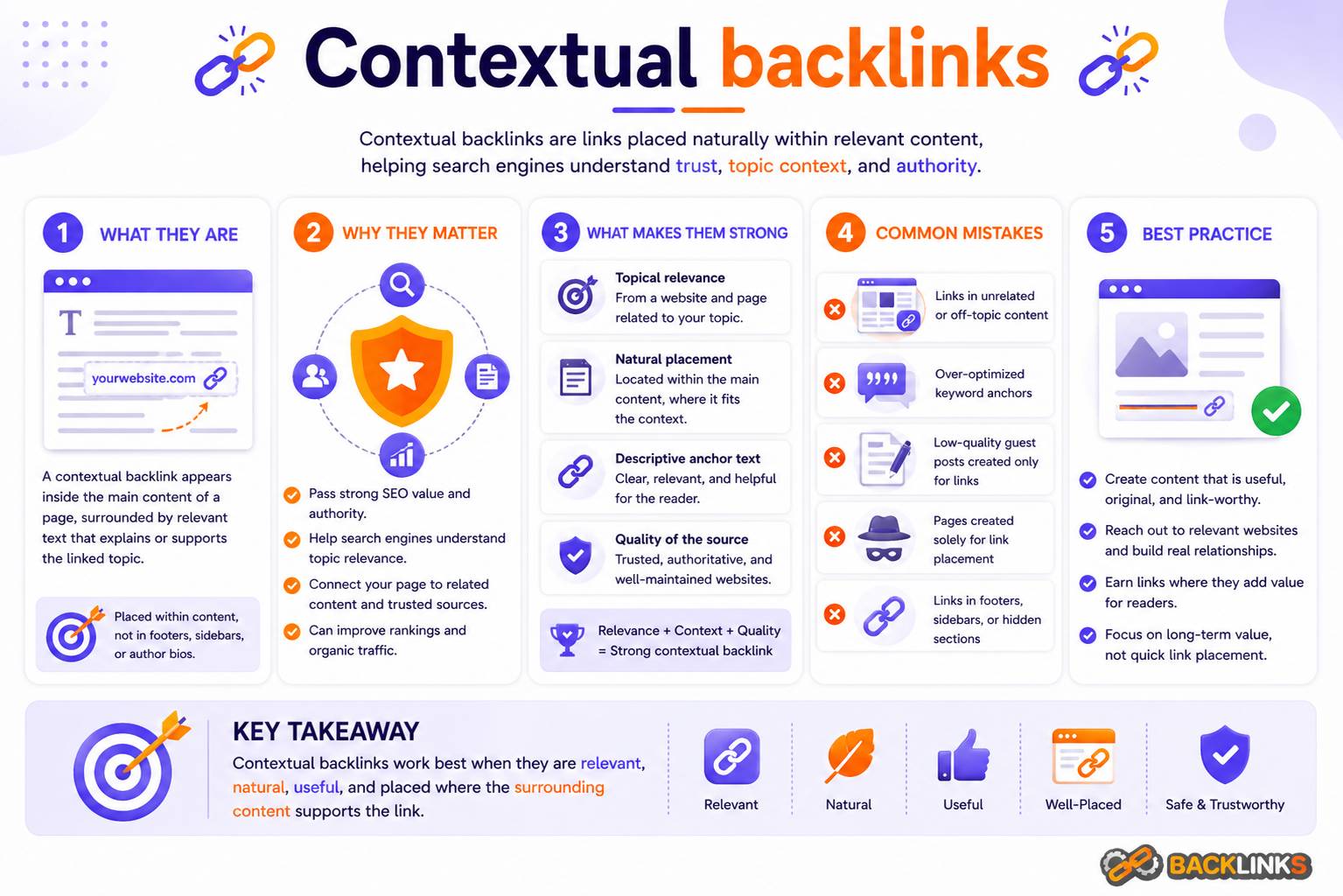
Contextual backlinks are links placed within relevant content on another website, usually inside the main body of an article, guide, or editorial page. They matter because search engines do not evaluate backlinks only by counting them; they also look at the context surrounding each link to understand relevance, trust, and topical connection.
For SEO, a backlink placed naturally inside a relevant paragraph is usually more valuable than a link placed in a footer, sidebar, directory list, or unrelated page. Context gives the link meaning. It helps both users and search engines understand why the linked page is useful.
This article explains what contextual backlinks are, how they work, why they are valuable, what makes them high quality, and how to earn them without relying on risky or manipulative tactics.
What Are Contextual Backlinks?
Contextual backlinks are hyperlinks that appear within the main content of a page and are surrounded by relevant text.
For example, if an SEO blog writes an article about linkbuilding strategies and links to your guide about backlink analysis inside a paragraph explaining how to evaluate links, that is a contextual backlink.
The key point is relevance. The link is not isolated or placed randomly. It appears within content that gives the link a clear purpose.
A contextual backlink usually answers one of these questions for the reader:
Why is this link useful here?
What additional information does it provide?
How does it support the topic being discussed?
If the link fits naturally within the content and helps the reader understand the subject better, it has strong contextual value.
Why Context Matters in Backlinks
Search engines aim to understand relationships between pages. A backlink is not evaluated in isolation. The surrounding content helps search engines interpret the meaning of the link.
A contextual backlink provides several layers of information:
- The topic of the linking page
- The words around the link
- The anchor text used
- The relationship between the source page and destination page
- The likely usefulness of the link for readers
This makes contextual backlinks more meaningful than links placed without explanation.
For example, a link to an article about linkbuilding from a relevant SEO guide sends a clearer signal than the same link placed on an unrelated page about travel, fashion, or general lifestyle content.
The stronger the context, the easier it is for search engines to understand why the link exists.
Why Contextual Backlinks Matter for SEO
They Support Relevance
Relevance is one of the most important qualities of a strong backlink. Contextual backlinks help reinforce relevance because they are placed within content related to the linked page.
If your page is about backlinks and another page links to it while discussing SEO authority, anchor text, or linkbuilding, the connection is clear.
This helps search engines associate your page with the correct topic.
They Can Strengthen Authority
A contextual backlink from a trusted website can help strengthen your page’s authority. When that link appears naturally within useful content, it may carry more SEO value than a link placed in a less meaningful location.
Authority is not only about the domain linking to you. It also depends on the quality of the specific page, the relevance of the content, and the way the link is presented.
They Improve User Experience
A good contextual backlink helps readers continue their learning journey.
If someone is reading about SEO strategy and sees a relevant link to a deeper explanation of backlinks, that link improves the experience. It gives the user a useful next step without interrupting the flow of the content.
Search engines increasingly reward content that is helpful and well connected. Contextual links support this by making information easier to navigate.
They Look More Natural
Natural backlink profiles include links that make editorial sense. Contextual backlinks often appear more natural because they are integrated into real content.
A link placed inside a relevant discussion is easier to justify than a link added to a random list, sidebar, or unrelated page.
This does not mean every contextual link is automatically safe or valuable. But when earned properly, contextual backlinks tend to align with how real citations and recommendations happen online.
Contextual Backlinks vs Non-Contextual Backlinks
The difference between contextual and non-contextual backlinks is where and how the link appears.
A contextual backlink is placed within relevant content. It is surrounded by text that explains or supports the link.
A non-contextual backlink may appear in areas such as:
- Footers
- Sidebars
- Blog comment sections
- Generic directories
- Author bios
- Random link lists
Non-contextual backlinks are not always useless. Some can still drive referral traffic or support brand visibility. However, they often provide weaker topical signals because the link is not supported by meaningful surrounding content.
For SEO, contextual backlinks are usually more valuable because they connect the linked page to a specific topic in a clearer way.
What Makes a Contextual Backlink High Quality?
Not all contextual backlinks are equal. A link can appear inside content and still provide limited value if the page is weak, irrelevant, or poorly written.
A high-quality contextual backlink usually has the following characteristics.
Relevant Source Content
The linking page should be closely related to your topic.
For example, a backlink to a page about linkbuilding is more valuable when it comes from content about SEO, digital marketing, search rankings, content strategy, or website authority.
A link from an unrelated article may look unnatural, even if it appears inside the content.
Trusted Website
The linking website should have signs of credibility. It should publish useful content, serve a real audience, and avoid spammy linking patterns.
A smaller niche website can still be valuable if it is relevant and trusted within its space. A large website is not automatically better if the link is unrelated or placed carelessly.
Natural Anchor Text
Anchor text is the clickable text of a hyperlink. For contextual backlinks, anchor text should describe the linked page naturally.
Good anchor text may be branded, descriptive, or partial-match. It should help users understand what they will find after clicking.
Overusing exact-match anchor text can make a backlink profile look manipulative. For example, if every link to a page uses the same commercial keyword, that pattern can appear unnatural.
Editorial Placement
A strong contextual backlink should feel like part of the content, not an advertisement inserted for SEO.
The link should support the surrounding paragraph. It should help explain a concept, provide a useful reference, or guide readers to deeper information.
Useful Destination Page
The linked page itself must be worth referencing. Even a strong contextual placement will not deliver long-term value if the destination page is thin, outdated, unclear, or overly promotional.
The best contextual backlinks point to pages that genuinely help users.
Examples of Contextual Backlinks
A contextual backlink may appear in several natural situations.
An industry blog might mention your guide while explaining a related concept.
A journalist might link to your research when supporting a point in an article.
A resource page might include your guide with a short explanation of why it is useful.
A guest article might link to a deeper supporting resource on your site when it adds value for readers.
A business partner might reference your case study in an article about a shared project.
In all of these examples, the backlink works because it fits the content. The link is not random. It supports the reader’s understanding.
How to Earn Contextual Backlinks
Create Content Worth Referencing
The foundation of earning contextual backlinks is strong content.
Websites are more likely to link to pages that provide clear value, such as:
- Detailed guides
- Original research
- Practical frameworks
- Expert explanations
- Useful tools or templates
- Case studies
- Clear visual resources
If your content does not add anything useful, it will be difficult to earn strong contextual links.
Target Relevant Websites
Outreach should focus on websites that already cover related topics. Relevance is more important than scale.
A backlink from a smaller but highly relevant website can be more useful than a link from a broad, unrelated site.
Before reaching out, review the website’s content. Look for pages where your resource would genuinely improve the article.
Use Value-Focused Outreach
Effective outreach is not simply asking for a link. It explains why your content is useful and where it fits.
A strong outreach message should be specific. It should mention the relevant page, explain the connection, and show how the link helps the reader.
Generic outreach usually fails because it does not demonstrate relevance.
Build Linkable Assets
Some content formats naturally attract contextual backlinks more easily than others.
Examples include original data, comparison guides, industry glossaries, checklists, statistics pages, and practical tutorials.
These assets give writers and editors a reason to reference your content within their own articles.
Monitor Mentions and Unlinked References
Sometimes websites mention your brand, product, or content without linking to your site. These unlinked mentions can become contextual backlink opportunities.
If the mention already exists within relevant content, requesting a link can be reasonable, especially when the link would help readers find the original source.
Common Mistakes With Contextual Backlinks
One common mistake is assuming that every in-content link is valuable. Context alone is not enough. The linking page must also be relevant, trustworthy, and useful.
Another mistake is over-optimizing anchor text. Contextual backlinks should use natural language. Repeated exact-match anchor text can reduce trust.
Some websites also pursue contextual links from unrelated pages because the domain appears strong. This can lead to weak relevance signals.
Another issue is creating low-quality guest posts only to insert links. If the content exists mainly for link placement, it is unlikely to provide lasting SEO value.
Finally, many businesses send mass outreach emails without personalization. Contextual backlink opportunities require careful targeting. Relevance cannot be automated effectively at scale.
Practical Guidance for Using Contextual Backlinks Strategically
Start by identifying the pages on your website that deserve contextual links. These are usually useful informational resources, important guides, original research, or pages that support your broader SEO strategy.
Then evaluate your content gaps. If your pages are too thin or too similar to existing resources, improve them before outreach.
Next, research websites that already discuss related topics. Look for articles where your content would naturally support a point, answer a question, or provide a deeper explanation.
When you earn contextual backlinks, support them with strong internal linking. If a page receives external authority, internal links can help distribute that value to related pages on your site.
This approach connects linkbuilding with content strategy. Instead of building links randomly, you build authority around the topics that matter most.
Timing and Expectations
Contextual backlinks are often harder to earn than basic directory links or profile links because they require relevance, editorial judgment, and strong content.
Results may take time. Search engines need to crawl the linking page, evaluate the link, and understand how it fits within your overall backlink profile.
A few strong contextual backlinks can be more valuable than many weak links, but they should be built consistently. Sustainable SEO growth comes from steady, relevant authority signals over time.
Conclusion
Contextual backlinks are among the most valuable types of backlinks because they combine authority with relevance. They appear within meaningful content, help users discover useful resources, and give search engines clearer signals about the relationship between pages.
The best contextual backlinks are earned from relevant, trustworthy websites and placed naturally within content that supports the link. They use natural anchor text, point to useful pages, and make sense for real readers.
For long-term SEO, contextual backlinks should not be treated as a shortcut. They should be part of a broader strategy built on strong content, thoughtful outreach, and clear topical relevance.
When earned properly, contextual backlinks help build authority, improve visibility, and strengthen the credibility of your website over time.