
Backlink Quality Assessment: How to Evaluate Links Before They Help or Harm Your SEO
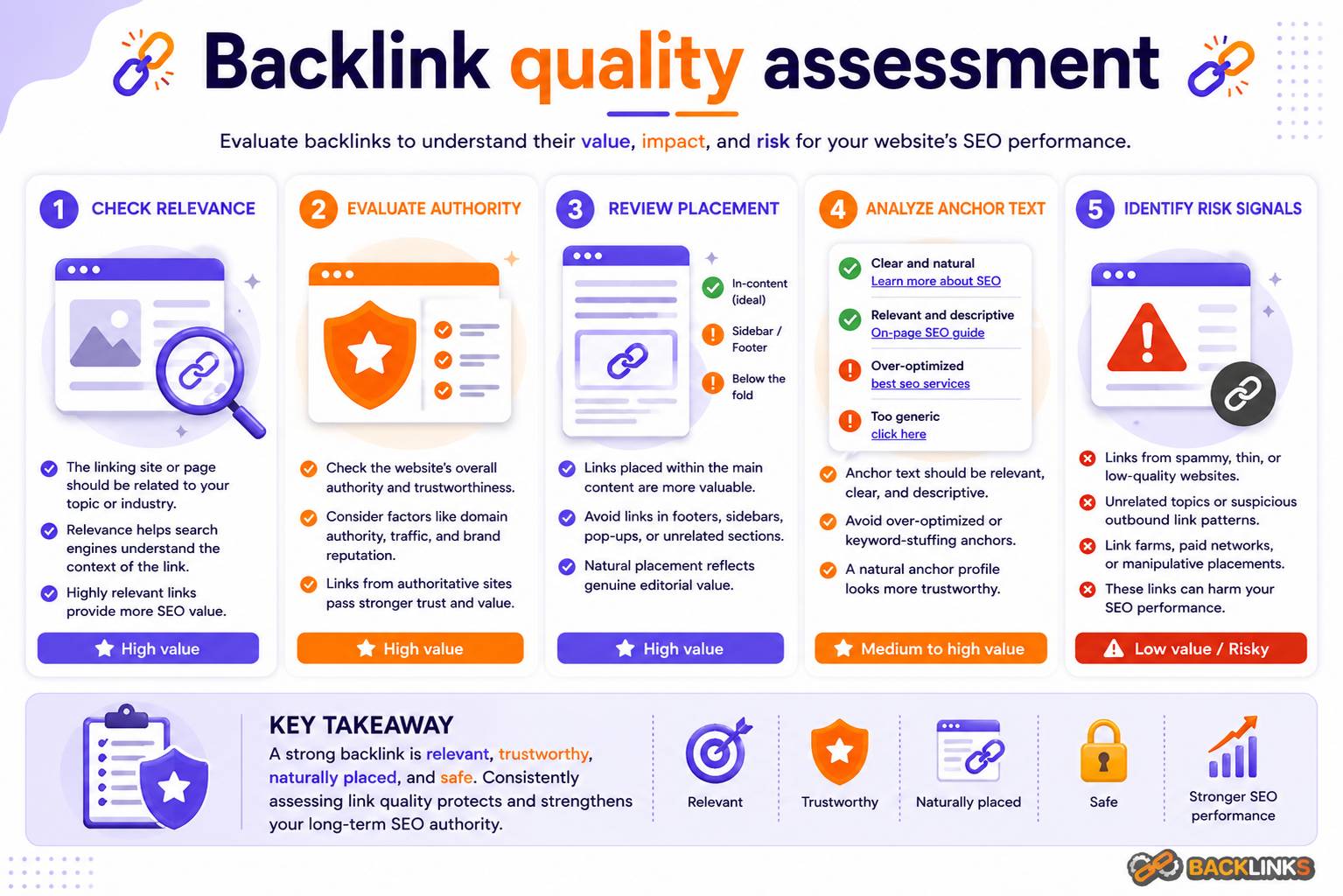
Backlink quality assessment is the process of evaluating whether a backlink is likely to support your SEO performance, provide real value, or create unnecessary risk. Not every backlink pointing to your website is useful. Some links can strengthen authority, improve rankings, and send relevant referral traffic, while others may be weak, irrelevant, artificial, or potentially harmful.
For businesses investing in SEO, assessing backlink quality is essential. A strong backlink profile is not built by collecting as many links as possible. It is built by earning links from relevant, trustworthy sources that make sense for users and search engines.
This article explains what backlink quality assessment means, why it matters, which factors to review, and how to judge backlinks with a practical SEO mindset. It follows the writing and structure requirements from the uploaded SEO content guidelines.
What Is Backlink Quality Assessment?
Backlink quality assessment is the practice of reviewing backlinks to determine their SEO value, relevance, trustworthiness, and risk level.
A backlink is a hyperlink from another website to your website. Search engines may use backlinks as signals of authority and relevance, but they do not treat every backlink equally.
A backlink from a respected industry website is very different from a backlink from a spammy directory, unrelated blog network, or automatically generated page. The first may support your SEO growth. The second may provide little value or weaken the trustworthiness of your backlink profile.
Backlink quality assessment helps answer questions such as:
- Is this link relevant to our website?
- Does the linking page appear trustworthy?
- Is the link placed naturally?
- Could this link help rankings, referral traffic, or brand credibility?
- Does this link create any risk?
The goal is not to judge backlinks using one metric alone. It is to evaluate the full context of the link.
Why Backlink Quality Assessment Matters
Backlink quality assessment matters because backlinks influence how search engines understand authority, credibility, and relevance.
A website with many low-quality links may not perform better than a website with fewer but stronger links. In competitive SEO, quality often matters more than quantity.
Assessing backlink quality helps you avoid wasting time on weak linkbuilding tactics. It also helps you identify which links are worth protecting, which opportunities are worth pursuing, and which patterns may need closer review.
For example, if a page earns backlinks from relevant websites in the same industry, that can strengthen topical authority. But if the same page receives many links from unrelated, low-quality domains, those links may not contribute meaningful value.
Backlink quality assessment also helps protect long-term performance. Search engines are better at identifying manipulative linking patterns than they were in the past. A careful review process reduces the risk of relying on tactics that may stop working or create problems later.
How Search Engines Evaluate Backlinks
Search engines evaluate backlinks using multiple signals. They do not simply count links.
A backlink may be assessed based on the linking website, the specific page, the anchor text, the surrounding content, and the overall link pattern.
A link that appears naturally within a relevant article usually sends a clearer signal than a link placed in a random sidebar, footer, or unrelated directory. Context matters because it helps search engines understand why the link exists.
Search engines may also consider whether a link appears editorially earned or artificially placed. A link given because the content is genuinely useful is generally more valuable than a link created only to influence rankings.
This is why backlink quality assessment should focus on meaning, not just metrics.
Key Factors in Backlink Quality Assessment
Relevance of the Linking Website
Relevance is one of the most important factors when assessing backlink quality.
A backlink from a website in your industry, niche, or related topic area is usually more valuable than a link from an unrelated site.
For example, if your website focuses on SEO, a backlink from a marketing blog, search industry publication, SaaS website, or business resource may be relevant. A link from a random gaming, fashion, or unrelated lifestyle site may be less meaningful unless there is a clear contextual reason.
Relevance should be evaluated at several levels:
- The overall domain topic
- The specific linking page topic
- The paragraph surrounding the link
- The relationship between the linking page and your destination page
A relevant backlink helps search engines understand your topical authority more clearly.
Authority and Trustworthiness
Authority matters, but it should not be judged only by third-party scores.
SEO tools often provide metrics such as domain authority, domain rating, or authority score. These can be useful for comparison, but they are not direct search engine metrics. They should support judgment, not replace it.
A trustworthy linking website usually has:
- Clear ownership or editorial standards
- Useful, original content
- A real audience
- Relevant traffic potential
- A natural backlink profile of its own
- No obvious spam patterns
A smaller niche website can be more valuable than a large unrelated domain if it has strong relevance and credibility.
Quality of the Linking Page
The quality of the specific linking page matters as much as the domain.
A good linking page should have clear content, useful information, and a real reason for users to engage with it. A weak linking page may be thin, duplicated, auto-generated, overloaded with outbound links, or created only for SEO purposes.
When assessing a backlink, review the page itself. Ask whether the page would still be useful if the link to your website did not exist.
If the answer is no, the link may be weak.
Link Placement
Where the link appears on the page affects its value.
A backlink placed naturally inside the main body content is usually stronger than a link placed in a footer, sidebar, author bio, comment section, or generic directory listing.
Main-content links are valuable because they are more likely to be editorial and useful for readers. They are also surrounded by relevant text, which gives search engines more context.
This is why contextual backlinks are often considered stronger than isolated links.
Anchor Text
Anchor text is the clickable text used in a hyperlink. It helps users and search engines understand what the linked page is about.
Good anchor text should be natural, relevant, and varied. It may include branded terms, partial-match phrases, descriptive wording, or a plain URL.
A backlink profile that contains too many exact-match anchors can look unnatural. For example, if most links to a page use the same keyword phrase, that pattern may suggest manipulation.
Backlink quality assessment should look at both individual anchor text and overall anchor text distribution.
Link Attributes
Some backlinks include attributes that tell search engines how to interpret them.
Common link attributes include:
rel="nofollow"rel="sponsored"rel="ugc"
A followed link may pass stronger ranking signals, but nofollow, sponsored, and UGC links are not automatically useless. They can still drive traffic, support visibility, and contribute to a natural link profile.
However, if a paid or sponsored link is not properly marked, it may create risk. Link attributes should match the nature of the relationship.
Traffic and User Value
A backlink should ideally have value beyond SEO.
If a link can send relevant visitors to your website, it is often more meaningful. Referral traffic suggests that the link is visible, useful, and placed where real users may click.
A link from a lower-authority website with a highly relevant audience may be more valuable than a link from a stronger domain where no one is likely to engage.
Good backlink quality assessment considers whether the link helps real people, not just search engines.
Signs of a High-Quality Backlink
A high-quality backlink usually has several of these qualities:
- It comes from a relevant website
- It appears on a useful, well-written page
- It is placed naturally within the main content
- It uses natural anchor text
- It points to a relevant destination page
- It may send qualified referral traffic
- It comes from a website with real editorial standards
- It fits naturally into the broader content
The strongest backlinks are not always the easiest to get. They are earned because the linked content provides value.
Signs of a Low-Quality or Risky Backlink
A low-quality backlink may show warning signs such as:
- Irrelevant linking website
- Thin or auto-generated content
- Excessive outbound links
- Obvious paid link placement without proper disclosure
- Exact-match anchor text repeated unnaturally
- Links from private blog networks or link farms
- Links from hacked, spammy, or abandoned websites
- No clear user value
One weak backlink is usually not a major issue by itself. The bigger concern is pattern. If many backlinks share the same low-quality traits, the overall profile may become less trustworthy.
How to Conduct a Backlink Quality Assessment
Start by collecting backlink data from SEO tools such as Google Search Console, Ahrefs, Semrush, Moz, Majestic, or other backlink analysis platforms.
Then group backlinks by domain, page, anchor text, and link type. This helps you identify patterns rather than reviewing links in isolation.
Next, evaluate the most important links first. Prioritize links from domains that appear authoritative, links to key pages, links with unusual anchor text, and links from suspicious sources.
For each backlink, review:
- The linking domain
- The linking page
- The content surrounding the link
- The anchor text
- The destination page
- The link attribute
- The potential user value
Avoid making decisions based only on automated toxicity scores. These scores can be useful for prioritization, but manual judgment is still important.
Common Mistakes in Backlink Quality Assessment
One common mistake is relying too heavily on domain authority metrics. These scores are helpful, but they do not tell the full story.
Another mistake is assuming every low-authority link is bad. New or niche websites may still be relevant and valuable.
Some businesses also panic when they see spammy backlinks. Most websites naturally attract some low-quality links over time. The real issue is whether those links form a manipulative pattern or appear to be part of your own linkbuilding activity.
Another mistake is ignoring anchor text distribution. Even strong backlinks can create risk if the overall pattern looks unnatural.
Finally, many teams assess backlinks only after a ranking drop. Backlink quality should be reviewed regularly, not only during problems.
Practical Guidance for Better Link Evaluation
A practical backlink review process should be consistent and realistic.
Do not reject a link just because one metric looks weak. Review the full context.
Do not pursue a link just because the domain score looks high. Relevance and placement matter.
Focus on links that make sense for users. If a real person would find the link helpful, that is usually a positive sign.
When building links, prioritize editorially placed links from relevant websites. When reviewing existing links, focus on patterns rather than isolated imperfections.
If you find suspicious links, document them carefully. In most cases, the best first step is analysis, not immediate disavowal. Disavowing links should be handled cautiously because removing signals unnecessarily can harm performance.
Timing and Expectations
Backlink quality assessment should be part of ongoing SEO maintenance.
For active websites, reviewing backlinks monthly or quarterly can help identify new opportunities, lost links, unusual patterns, and potential risks. For sites with aggressive linkbuilding campaigns or sudden ranking changes, more frequent reviews may be needed.
The impact of backlink quality is not always immediate. Search engines need time to crawl links, evaluate signals, and reflect changes in rankings.
A stronger backlink profile develops gradually through consistent, relevant, and trustworthy link acquisition.
Conclusion
Backlink quality assessment is essential for building a sustainable SEO strategy. It helps you understand which backlinks support authority, which links provide little value, and which patterns may create risk.
The best backlinks are relevant, trustworthy, contextual, naturally placed, and useful for real users. The weakest links are usually unrelated, artificial, spammy, or created only to manipulate rankings.
Effective assessment requires more than checking a score in an SEO tool. It requires evaluating relevance, authority, page quality, anchor text, placement, link attributes, and user value together.
When handled properly, backlink quality assessment helps you build a cleaner, stronger, and more resilient backlink profile that supports long-term organic growth.