
Linkbuilding Outreach: How to Earn Better Backlinks Through Strategic Relationship Building
Linkbuilding outreach is one of the most practical ways to earn backlinks, but it is also one of the easiest to execute poorly. Many outreach campaigns fail because they focus too much on asking for links and too little on creating a reason for someone to link.
Effective linkbuilding outreach is not mass emailing. It is a structured process of identifying relevant websites, understanding their content needs, and presenting a link opportunity that makes sense for both sides.
This article explains how linkbuilding outreach works, why it matters, and how to approach it professionally within a broader SEO and content strategy.
What Is Linkbuilding Outreach?
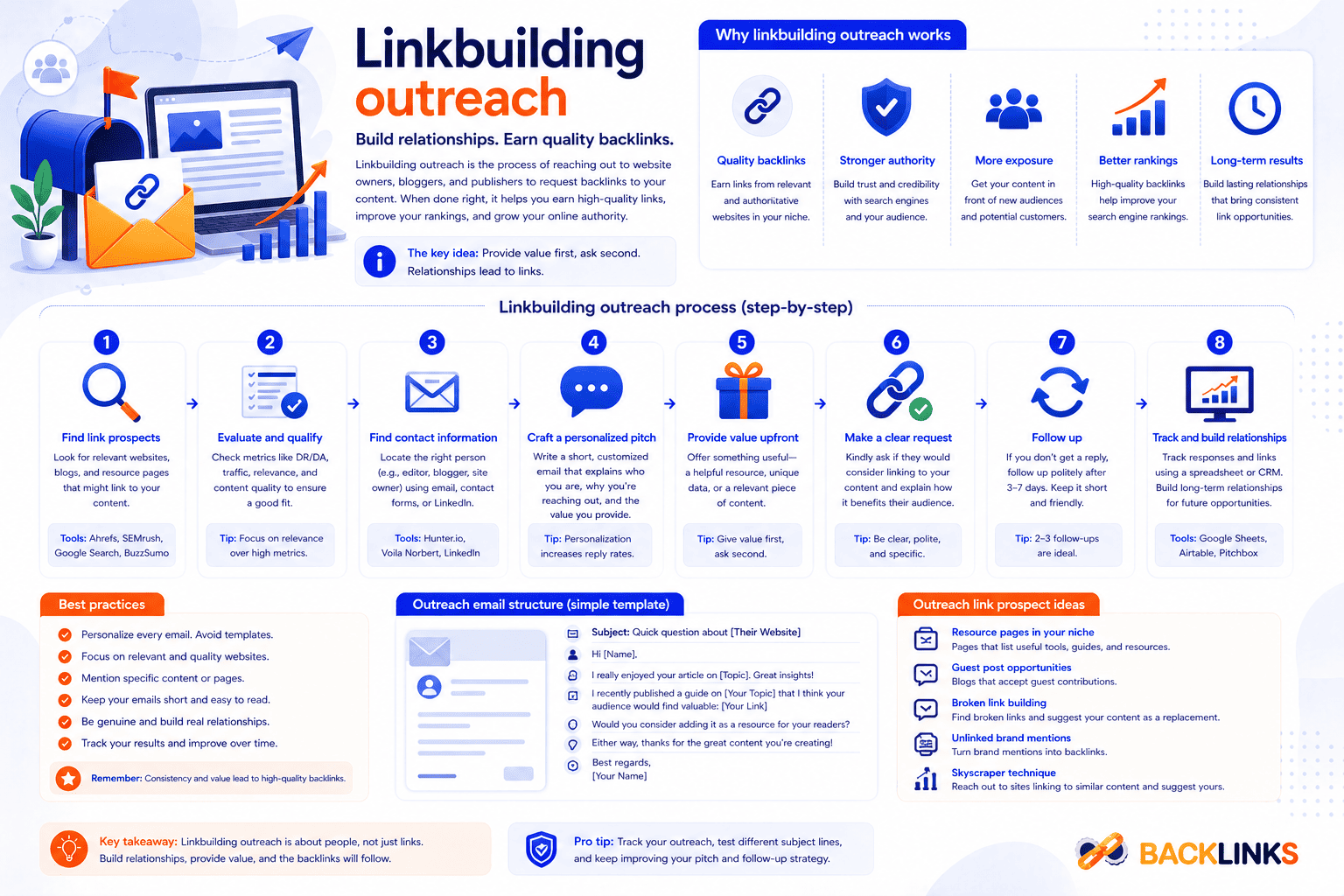
Linkbuilding outreach is the process of contacting website owners, editors, bloggers, or publishers to earn backlinks to your website.
In practical terms, it usually involves finding relevant prospects, evaluating whether your content fits their audience, contacting them with a clear proposal, and securing a contextual backlink.
The goal is not simply to acquire any link. The goal is to earn links from websites that are relevant, credible, and likely to strengthen your site’s authority.
This makes outreach different from automated link building or low-quality link exchanges. Good outreach depends on relevance, timing, and value.
Why Linkbuilding Outreach Matters
It Helps Build Relevant Authority
Backlinks from relevant websites help search engines understand where your site fits within a topic. When a trusted site in your niche links to your content, that link can reinforce topical authority and improve your ability to rank for related search terms.
It Supports Content Visibility
Even strong content often needs promotion. Outreach helps place your best content in front of publishers who may reference it, share it, or include it in relevant resources.
This is especially useful for linkable assets such as guides, research pages, tools, and strong cluster content.
It Creates Long-Term Opportunities
Outreach can also build relationships. A single successful placement may lead to future collaborations, guest blogging opportunities, niche edits, or editorial mentions.
This relationship-based value is often more durable than one-off link acquisition.
How Linkbuilding Outreach Works
Step 1: Define the Link Target
Before contacting anyone, decide which page you want to build links to and why.
Strong link targets usually include:
- Pillar pages that support a broad topic
- Cluster articles with useful, specific insight
- Linkbait content designed to attract references
- Commercial pages supported by strong informational context
For example, if your site has a core guide to linkbuilding, outreach can help strengthen that pillar page while internal links distribute authority to related cluster pages.
Step 2: Find Relevant Prospects
Prospecting is the foundation of outreach quality. Look for websites that publish content related to your topic and have a clear reason to reference your page.
Relevant prospects may include industry blogs, resource pages, niche publishers, associations, content creators, or websites with outdated references.
The best prospects are not just high-authority websites. They are sites where your content genuinely fits.
Step 3: Evaluate the Opportunity
Before sending an email, review the target website carefully.
Consider whether the site has real content quality, topical relevance, reasonable editorial standards, and existing articles where your link could add value.
If the site looks thin, outdated, unrelated, or built mainly to sell links, it may not be worth pursuing.
Step 4: Write a Clear Outreach Message
A good outreach email should be concise and specific. It should explain why you are reaching out, where your content fits, and how it helps the recipient’s audience.
Avoid generic praise, long introductions, and vague claims. Editors and site owners receive many outreach messages. Clarity is more persuasive than enthusiasm.
Step 5: Follow Up Professionally
A short follow-up can improve response rates, but overdoing it damages credibility. One or two polite follow-ups are usually enough.
If there is no response, move on and continue building a qualified prospect list.
Important Subtopics in Linkbuilding Outreach
Personalization
Personalization does not mean writing a long custom message for every prospect. It means showing that you understand the website and why your content is relevant.
A simple reference to a specific article or section is often enough when it is accurate and useful.
Value Proposition
The strongest outreach campaigns are built around value. Your content should help the recipient improve an article, update an old resource, fix a broken link, or provide additional context for readers.
Without a clear value proposition, outreach becomes just another link request.
Anchor Text Control
Outreach can give you some influence over anchor text, but it should not be forced. Natural anchors are safer and more sustainable than repeated exact-match keywords.
A balanced backlink profile includes branded anchors, partial-match phrases, URL anchors, and natural descriptive text.
Relationship with Other Linkbuilding Methods
Linkbuilding outreach supports several strategies, including guest blogging, broken link building, niche edits, and content marketing.
For example, outreach can help promote linkbait content, pitch guest posts, or suggest your page as a replacement for an outdated reference.
Common Mistakes
Sending Mass Generic Emails
Generic outreach rarely works. It signals low effort and gives the recipient no reason to respond.
Targeting Irrelevant Websites
A backlink from an unrelated site may add little value and can weaken topical relevance. Relevance should come before domain metrics.
Asking Before Offering Value
Many outreach messages focus entirely on what the sender wants. Better outreach explains what the recipient gains.
Over-Optimizing Anchor Text
Repeated keyword-heavy anchors can create unnatural patterns. This is especially risky when outreach is done at scale.
Ignoring Content Quality
Outreach cannot compensate for weak content. If the page you are promoting is thin, generic, or poorly structured, the campaign will struggle.
Practical Guidance
Build Outreach Around Strong Assets
Start with content that deserves links. This may be a detailed guide, a practical framework, a useful comparison, or a well-structured explanation of a specific topic.
If the asset is weak, improve it before starting outreach.
Segment Your Prospects
Not all prospects should receive the same message. Segment them by opportunity type, such as resource pages, blogs, guest post prospects, broken link opportunities, or existing mentions.
This makes your outreach more relevant and easier to scale responsibly.
Keep the Message Short
A strong outreach email usually includes three elements: why you are contacting them, what resource you are suggesting, and why it is useful.
Short, specific messages tend to perform better than long pitches.
Track Results and Refine
Monitor response rates, accepted placements, link quality, and eventual SEO impact. Over time, this helps identify which prospect types and messages work best.
Outreach improves with iteration.
Timing and Expectations
Linkbuilding outreach takes time. Prospecting, evaluation, communication, follow-ups, and placement can span weeks or longer.
Results also depend on the quality of your content, the relevance of your prospects, and the competitiveness of your niche.
In most cases, outreach should be treated as an ongoing process rather than a one-time campaign. The strongest results come from consistent execution and relationship building.
Conclusion
Linkbuilding outreach is not about sending as many emails as possible. It is about earning relevant backlinks by connecting the right content with the right websites.
When done well, outreach supports rankings, strengthens topical authority, and creates long-term relationships that can benefit future SEO work.
The most effective approach is practical and disciplined: build link-worthy assets, target relevant prospects, communicate clearly, and prioritize quality over volume.
Used as part of a broader linkbuilding strategy, outreach becomes a reliable method for building authority without relying on shortcuts.