
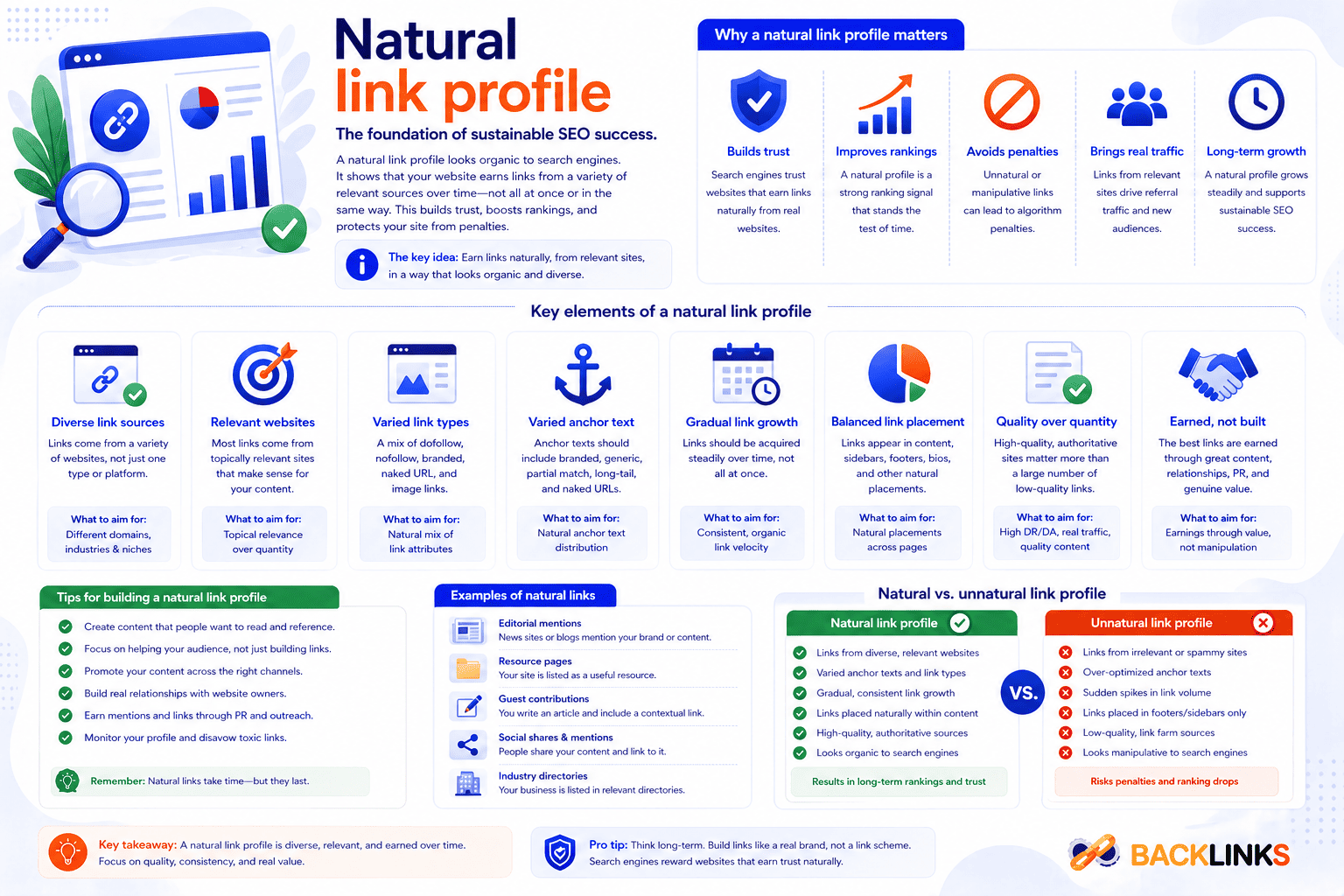
Natural Link Profile: What It Is and How to Build It for Long-Term SEO
In linkbuilding, the concept of a “natural” backlink profile is often mentioned but rarely defined clearly. Many websites focus on acquiring links without considering how those links appear collectively.
This is where problems begin. Even high-quality backlinks can lose impact—or introduce risk—if the overall pattern looks manipulated.
A natural link profile is not about randomness. It is about balance, diversity, and alignment with how links are earned organically across the web.
This article explains what a natural link profile is, why it matters in modern SEO, and how to build one strategically within a structured linkbuilding approach.
What is a Natural Link Profile
A natural link profile is a collection of backlinks that appears organic in terms of source, context, anchor text, and acquisition pattern.
In practical terms, it reflects how links would accumulate if a website earned them naturally over time, without artificial manipulation.
Key characteristics include:
- A mix of different link types
- Varied anchor text
- Links from relevant and diverse domains
- Gradual growth rather than sudden spikes
Importantly, a natural link profile is not perfect. It includes variation and even some low-quality links, as this reflects real-world linking behavior.
Why a Natural Link Profile Matters
Supports Stable Rankings
Search engines evaluate backlink profiles holistically. A natural profile reinforces trust signals, making rankings more stable over time.
Unnatural patterns, even with strong individual links, can reduce effectiveness or trigger devaluation.
Reduces Risk of Penalties
A natural link profile lowers the likelihood of issues related to google penalties backlinks. When link patterns align with expected behavior, they are less likely to be flagged as manipulative.
Improves Linkbuilding Efficiency
When your profile is balanced, new backlinks tend to have more impact. There is less “noise” from low-value or suspicious links.
Aligns with Long-Term SEO Strategy
A natural profile supports sustainable growth. It integrates well with content-driven linkbuilding, outreach, and other strategies without creating conflicting signals.
How a Natural Link Profile Works
Search engines assess backlink profiles based on patterns, not individual links. Building a natural profile requires managing these patterns over time.
Diversity of Link Sources
Links should come from a range of domains, including:
- Blogs
- News or editorial sites
- Niche-specific websites
- Resource pages
This diversity signals that your site is referenced across different parts of the web.
Variation in Anchor Text
A natural profile includes a mix of anchor types:
- Branded anchors
- URL anchors
- Generic phrases
- Partial keyword phrases
Overuse of exact-match keywords is one of the clearest signs of manipulation.
Contextual Relevance
Links should be placed within content that is relevant to your topic. Context reinforces the meaning of the link and improves its SEO value.
Gradual Link Acquisition
Natural link growth happens over time. Sudden spikes in backlinks, especially from similar sources, can appear unnatural.
Important Subtopics in Natural Link Profile
Anchor Text Distribution
Anchor text plays a central role in how natural a profile appears.
A balanced distribution avoids heavy concentration on commercial keywords. Instead, it reflects how real users and publishers reference content—often using brand names, URLs, or descriptive phrases.
Link Type Variation
A natural link profile includes different types of links, such as:
- Editorial links from articles
- Guest blogging placements
- Mentions without direct promotion
- Contextual links within existing content
Relying on a single method, such as only niche edits or only paid links, creates patterns that may reduce trust.
Relevance Across Topics
Links should align with your site’s core topics. A profile filled with unrelated links weakens topical authority.
For example, if your site focuses on linkbuilding, backlinks from SEO-related content are more valuable than links from unrelated industries.
Integration with Content Clusters
Within a pillar-and-cluster model, a natural link profile supports the entire structure.
Backlinks to a central pillar page can strengthen related cluster pages through internal linking. This creates a more efficient distribution of authority across your site.
Common Mistakes
Over-Optimizing Anchor Text
Using the same keyword repeatedly across backlinks creates unnatural patterns. This is one of the most common issues in aggressive linkbuilding.
Relying on One Link Source
Building links only through one method—such as guest posts or paid placements—reduces diversity and makes the profile easier to identify as manipulated.
Ignoring Relevance
Links from unrelated sites may not contribute meaningfully to SEO performance and can weaken the overall profile.
Building Links Too Quickly
Rapid link acquisition without a clear pattern can appear artificial. Growth should be steady and aligned with content development.
Practical Guidance
Focus on Balance, Not Perfection
A natural link profile does not require eliminating every low-quality link. Instead, focus on maintaining balance across:
- Link types
- Anchor text
- Source diversity
Align Linkbuilding with Content Strategy
Strong content supports natural link acquisition. For example, linkbait content or high-value guides can attract organic backlinks, improving profile quality.
Combine Multiple Linkbuilding Methods
Use a mix of strategies, such as:
- Linkbuilding outreach
- Guest blogging
- Content-driven link acquisition
- Selective niche edits
This diversity helps create a more natural pattern.
Monitor Patterns Regularly
Regular backlink audits help identify:
- Anchor text imbalances
- Unusual spikes in link acquisition
- Over-reliance on specific domains
This allows you to adjust your strategy before issues develop.
Timing and Expectations
Building a natural link profile takes time. It is the result of consistent effort rather than a one-time campaign.
In most cases:
- Early improvements may appear within weeks
- Stronger authority develops over months
- Long-term stability comes from sustained link diversity and relevance
Patience is essential. Attempting to accelerate the process artificially often leads to problems.
Conclusion
A natural link profile is not about avoiding linkbuilding—it is about doing it in a way that aligns with how links are expected to appear.
By focusing on diversity, relevance, and gradual growth, you create a backlink profile that supports stable rankings and long-term authority.
Rather than chasing individual links, the goal should be to manage the overall pattern. When your link profile reflects genuine value and consistent strategy, it becomes a foundation for sustainable SEO performance.