
How Many Backlinks Needed: A Practical Way to Estimate Link Requirements for SEO
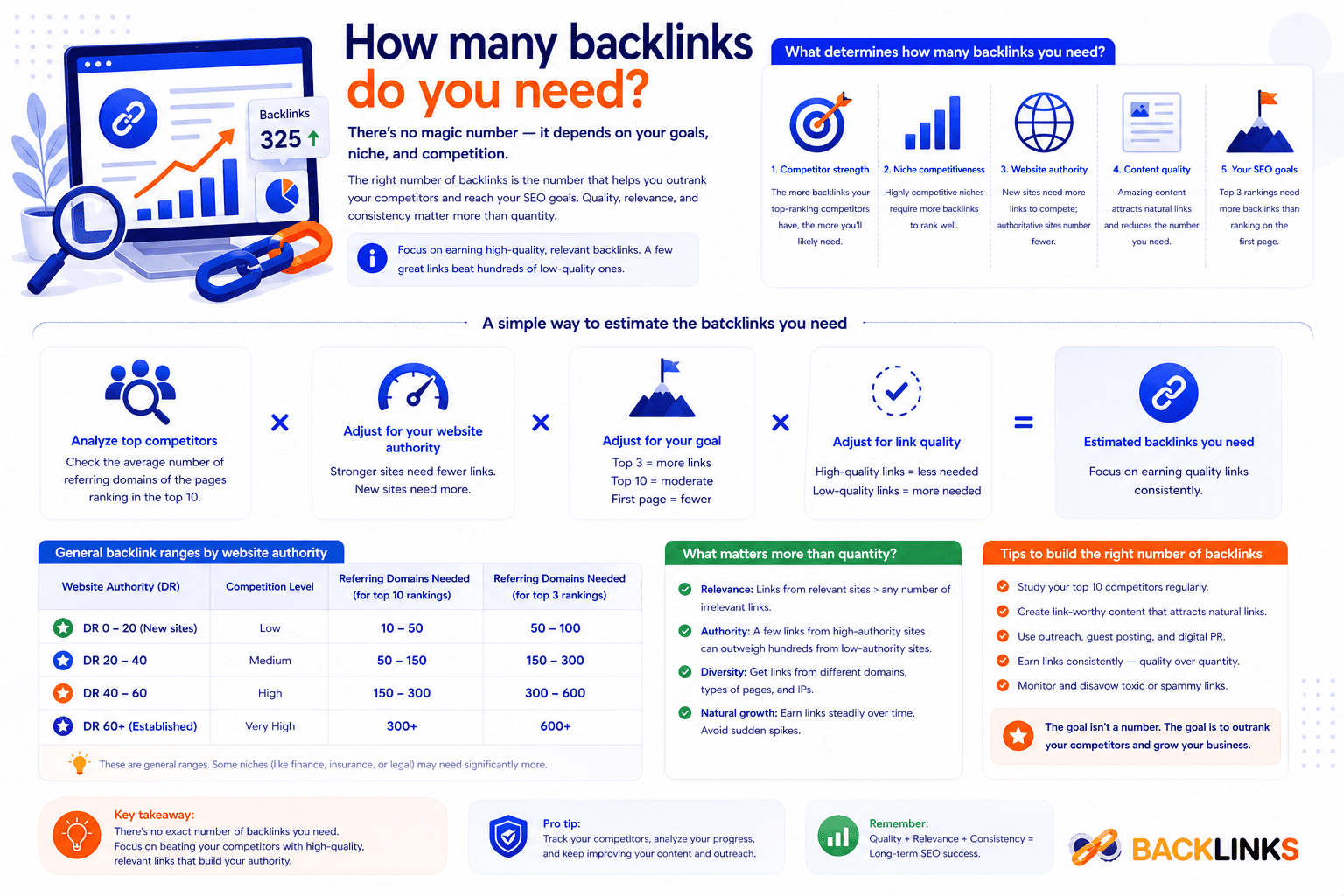
One of the most common questions in SEO is: how many backlinks needed to rank on Google? It is a reasonable question, but the answer is rarely a fixed number.
Backlinks matter because they help search engines evaluate authority, trust, and relevance. However, rankings are not determined by backlink quantity alone. A page with fewer high-quality, relevant backlinks can outperform a page with many weak or unrelated links.
The real objective is not to chase an arbitrary backlink count. It is to understand how many quality links your page needs relative to competition, search intent, content quality, and overall website authority.
This article explains how to estimate backlink needs in a practical and strategic way.
What Does “How Many Backlinks Needed” Really Mean?
When people ask how many backlinks are needed, they usually want to know how much linkbuilding effort is required to rank for a target keyword.
In practice, the question should be reframed:
How strong does my page need to be compared with the pages already ranking?
That strength depends on several factors:
- The authority of competing pages
- The quality and relevance of their backlinks
- The strength of their domain
- The search intent behind the keyword
- The quality and depth of their content
A backlink count alone can be misleading. Ten relevant links from trusted industry websites may be more valuable than hundreds of low-quality links from unrelated domains.
Why Backlink Quantity Matters, But Only in Context
Backlinks are still one of the strongest authority signals in SEO. If your competitors have strong backlink profiles and your page has none, ranking can be difficult.
However, quantity only matters when evaluated alongside quality.
A useful backlink should ideally be:
- Relevant to your topic
- Placed within meaningful content
- From a trustworthy website
- Supported by natural anchor text
- Part of a balanced backlink profile
If links lack these qualities, increasing volume may not improve rankings. In some cases, poor linkbuilding can create risk rather than value.
How to Estimate How Many Backlinks You Need
Analyze the Top-Ranking Pages
Start by reviewing the pages currently ranking for your target keyword. Look at the number of referring domains pointing to each page, not just total backlinks.
Referring domains are usually more useful than raw backlink count because multiple links from the same domain may have limited additional value.
The goal is not to copy competitors exactly, but to understand the competitive range.
Compare Page-Level Authority
Some pages rank because the specific page has strong backlinks. Others rank because the entire domain is highly authoritative.
If your domain is newer or weaker, you may need more page-level links to compete. If your domain already has strong authority, fewer links may be required.
Evaluate Content Quality
Backlinks cannot fully compensate for weak content. If your page does not satisfy search intent, additional links may have limited impact.
Before building links, assess whether your content is:
- More useful than competing pages
- Better structured
- Aligned with search intent
- Internally linked from relevant pages
- Clear enough for users and search engines
A stronger page usually needs fewer backlinks to compete.
Consider Keyword Difficulty and Intent
Informational keywords may require fewer commercial authority signals if the content is exceptionally helpful. Commercial keywords, especially in competitive niches, often require stronger backlink support.
For example, a guide explaining a niche SEO concept may need fewer backlinks than a service page targeting a high-value transactional keyword.
Important Factors That Affect Backlink Requirements
Link Quality
Quality is the most important factor. A single contextual backlink from a relevant, trusted website can carry more weight than many unrelated links.
This is why strategies such as guest blogging, niche edits, and linkbuilding outreach should prioritize relevance and editorial fit.
Anchor Text Diversity
A natural anchor text profile matters. If every backlink uses the same exact keyword, the profile may look manipulated.
A healthy mix includes branded anchors, URL anchors, partial-match phrases, and natural descriptive text.
Internal Linking
Internal links can reduce the number of external backlinks needed by distributing authority across your site.
In a pillar-and-cluster structure, links to a main linkbuilding pillar page can support related cluster pages through smart internal linking.
Existing Domain Authority
A strong domain can rank new content with fewer backlinks because the site already has accumulated trust. A newer website usually needs more direct link support.
Competitor Strength
The number of backlinks needed depends heavily on who you are competing against. Ranking against small niche blogs is very different from competing with established publishers, marketplaces, or major SaaS brands.
Common Mistakes
Chasing a Fixed Number
There is no universal number of backlinks needed to rank. Any claim that every page needs a specific number oversimplifies SEO.
Counting All Backlinks Equally
Not all backlinks have the same value. Low-quality links may provide little benefit, even in large numbers.
Ignoring Search Intent
If your content does not match what users expect, backlinks alone will not solve the problem.
Building Links Too Quickly
Aggressive link acquisition can create unnatural patterns. A natural link profile grows steadily and includes diverse sources.
Sending Links to the Wrong Pages
Not every page deserves the same backlink investment. Focus on pages with clear ranking potential, business value, or strategic importance within your content cluster.
Practical Guidance
Start With a Competitor Benchmark
Review the top-ranking pages and identify the approximate number of quality referring domains they have. Use this as a directional benchmark, not a strict target.
Prioritize Pages Close to Ranking
Pages already ranking on page two or lower page one often benefit most from additional backlinks. They already have relevance; they may simply need more authority.
Improve Content Before Building Links
Before investing in backlinks, make sure the page is worth ranking. Improve structure, depth, clarity, internal links, and search intent alignment.
Build Fewer, Better Links
Focus on earning relevant links from credible websites. Quality usually produces better long-term results than volume.
Monitor Progress Over Time
Track ranking movement, organic traffic, and conversions. If rankings improve but conversions do not, the issue may be intent or page quality rather than link quantity.
Timing and Expectations
Backlinks do not usually produce immediate results. Search engines need time to discover, evaluate, and apply link signals.
In many cases, early movement may appear within a few weeks, but meaningful ranking improvements often take several months. More competitive keywords require longer timelines and consistent link acquisition.
The number of backlinks needed may also change over time as competitors continue building their own authority.
Conclusion
There is no fixed answer to how many backlinks needed for SEO success. The right number depends on competition, content quality, domain authority, keyword difficulty, and link relevance.
A better approach is to estimate backlink requirements based on competitor analysis and strategic priorities. Focus on quality, context, and authority rather than raw numbers.
When backlinks are built gradually, supported by strong content, and integrated into a clear internal linking structure, they become a long-term asset—not just a ranking tactic.