
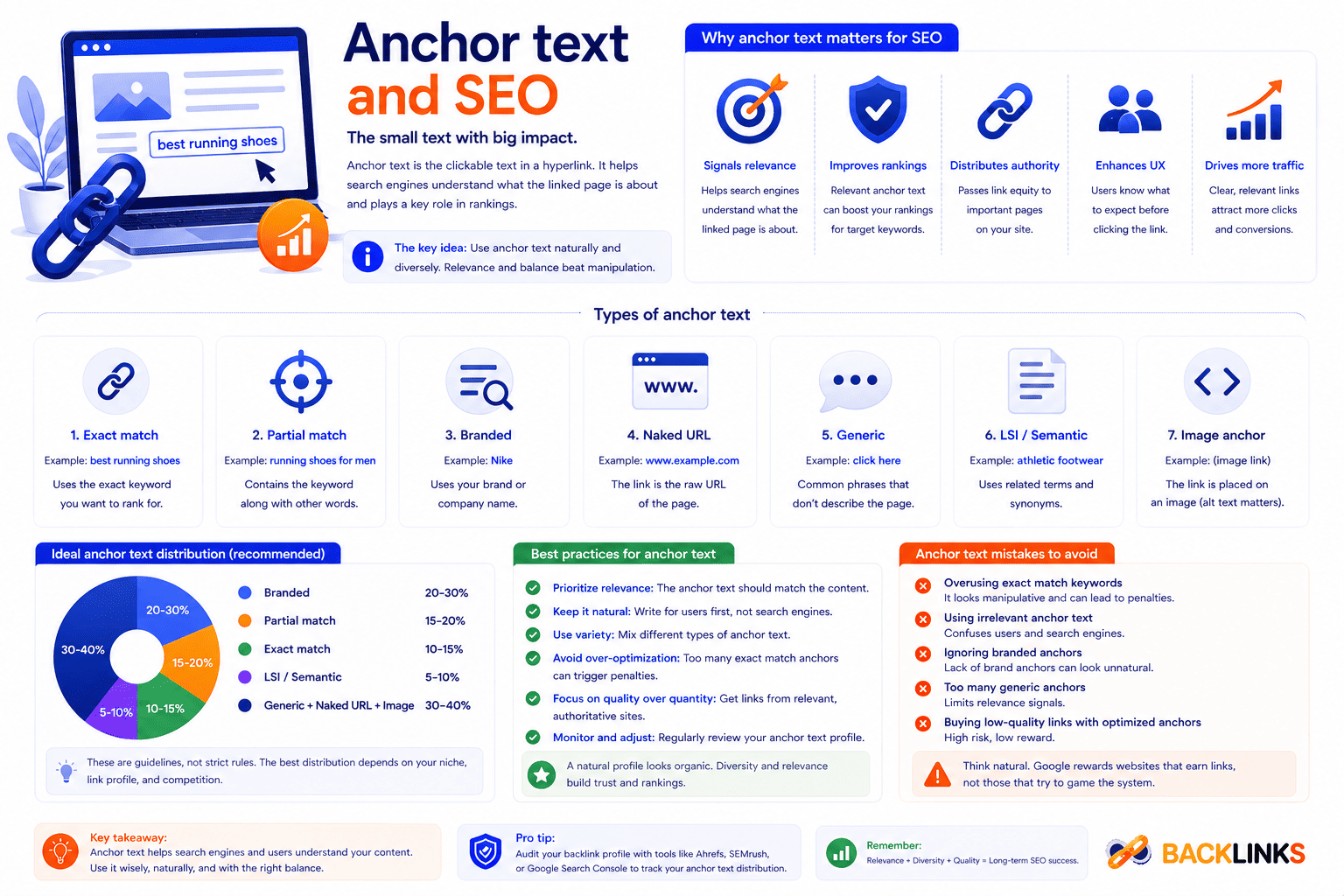
Anchor Text SEO: How to Use Anchor Text Strategically Without Risk
Anchor text is one of the most influential yet misunderstood elements of linkbuilding. While backlinks signal authority, the words used within those links help search engines understand context and relevance.
However, anchor text SEO is not about inserting keywords into every link. Over-optimization has historically been one of the fastest ways to trigger ranking issues.
The modern approach requires balance. Anchor text should reinforce relevance without creating patterns that appear manipulated.
This article explains what anchor text is, why it matters, and how to use it effectively within a structured SEO strategy.
What Is Anchor Text SEO?
Anchor text SEO refers to the practice of optimizing the clickable text in a hyperlink to improve search engine understanding of the linked page.
In simple terms, anchor text is the visible text users click on when navigating between pages. For example, a link labeled “linkbuilding strategy guide” provides more context than a generic “click here.”
From an SEO perspective, anchor text helps search engines:
- Interpret what the linked page is about
- Evaluate topical relevance
- Associate keywords with specific URLs
However, the way anchor text is used across your backlink profile matters more than any single link.
Why Anchor Text SEO Matters
Reinforces Keyword Relevance
Anchor text provides signals about the topic of a page. When used naturally, it helps search engines connect your page to relevant search queries.
Supports Topical Authority
Consistent, relevant anchor text across different domains reinforces your site’s expertise in a specific area. This is especially important in a content cluster structure.
For example, links pointing to a central linkbuilding page with varied but related anchors can strengthen its authority across multiple subtopics.
Influences Ranking Potential
While anchor text alone does not determine rankings, it contributes to how link signals are interpreted. Balanced anchor usage can support rankings, while over-optimization can weaken them.
Helps Users Understand Context
Anchor text is also a usability factor. Clear, descriptive anchors improve navigation and user experience, which indirectly supports SEO performance.
How Anchor Text SEO Works
Search engines analyze anchor text patterns across your backlink profile. The goal is to identify whether links appear natural or manipulated.
Distribution Across Link Types
Anchor text should vary across:
- External backlinks
- Internal links
- Editorial placements
A natural distribution includes different phrasing, not repeated exact keywords.
Contextual Relevance
Anchor text is evaluated alongside the surrounding content. A relevant anchor within a relevant article carries more value than a keyword placed in an unrelated context.
Relationship With Link Source
The authority and relevance of the linking page influence how anchor text is interpreted. Strong editorial links with natural anchors are typically more valuable than keyword-heavy links from low-quality sources.
Pattern Recognition
Search engines do not evaluate links in isolation. They look for patterns across your entire link profile.
If a large percentage of links use the same keyword, it can signal manipulation—even if individual links are high quality.
Important Subtopics in Anchor Text SEO
Types of Anchor Text
A balanced anchor text profile typically includes several types:
- Branded anchors (your business or domain name)
- URL anchors (raw URLs)
- Generic anchors (such as “this article” or “learn more”)
- Partial-match anchors (variations of keywords)
- Exact-match anchors (precise keyword phrases)
Each type plays a role in creating a natural distribution.
Internal vs External Anchor Text
Internal anchor text is fully under your control and can be used more strategically to reinforce page relevance.
External anchor text, especially from backlinks, should remain natural. Attempting to control it too aggressively can create unnatural patterns.
Anchor Text and Linkbuilding Methods
Different linkbuilding approaches produce different anchor patterns.
For example:
- Guest blogging often allows moderate control over anchors
- Linkbuilding outreach may result in more natural variation
- Linkbait content tends to generate organic anchors
Combining these methods helps maintain a balanced profile.
Anchor Text in Content Clusters
Within a pillar-and-cluster structure, anchor text plays a key role in internal linking.
Cluster pages can use varied, descriptive anchors to link back to a pillar page, reinforcing its importance without repeating the same keyword excessively.
Common Mistakes
Overusing Exact-Match Keywords
This is one of the most common issues. Repeating the same keyword across many backlinks creates a clear pattern that search engines may interpret as manipulation.
Ignoring Anchor Diversity
A profile dominated by one type of anchor—whether branded or keyword-based—can look unnatural.
Forcing Anchors Into Content
Anchor text should fit naturally within the sentence. Forced placement reduces readability and may weaken the link’s value.
Treating All Links the Same
Different types of links should use different anchor strategies. Applying the same approach across all backlinks limits effectiveness.
Neglecting Internal Anchor Strategy
Many websites focus only on external anchors while overlooking internal linking. Internal anchors are a powerful way to reinforce relevance.
Practical Guidance
Aim for Natural Distribution
Instead of targeting specific percentages, focus on maintaining a balanced mix of anchor types. Variation should reflect how people naturally link to content.
Use Exact Match Sparingly
Exact-match anchors can still be useful, but they should be used selectively and supported by a broader range of anchors.
Align Anchors With Context
Anchor text should match the surrounding content. A relevant anchor in a relevant article carries more value than a keyword placed out of context.
Leverage Internal Linking
Use internal links to strengthen key pages. Vary anchor text across different pages to avoid repetition while maintaining relevance.
Combine Linkbuilding Approaches
Different strategies produce different anchor patterns. Combining outreach, guest blogging, and content-driven linkbuilding helps create a more natural profile.
Timing and Expectations
Changes in anchor text distribution do not produce immediate results. Search engines need time to reassess link patterns and apply those signals.
In many cases:
- Adjustments may begin to influence rankings within weeks
- Full impact may take several months
- Long-term results depend on consistency and overall link quality
Anchor text should be managed continuously rather than adjusted in isolated campaigns.
Conclusion
Anchor text SEO is not about optimizing individual links—it is about managing patterns across your entire link profile.
A natural, balanced approach reinforces relevance while reducing risk. By focusing on variation, context, and integration with your broader linkbuilding strategy, anchor text becomes a supporting signal rather than a liability.
When used correctly, it strengthens both your content structure and your backlink profile, contributing to sustainable SEO performance over time.